
Car Camping Kitchen Setup: The Most Efficient 2-Burner Stove + Cook Kit Combos (2026)
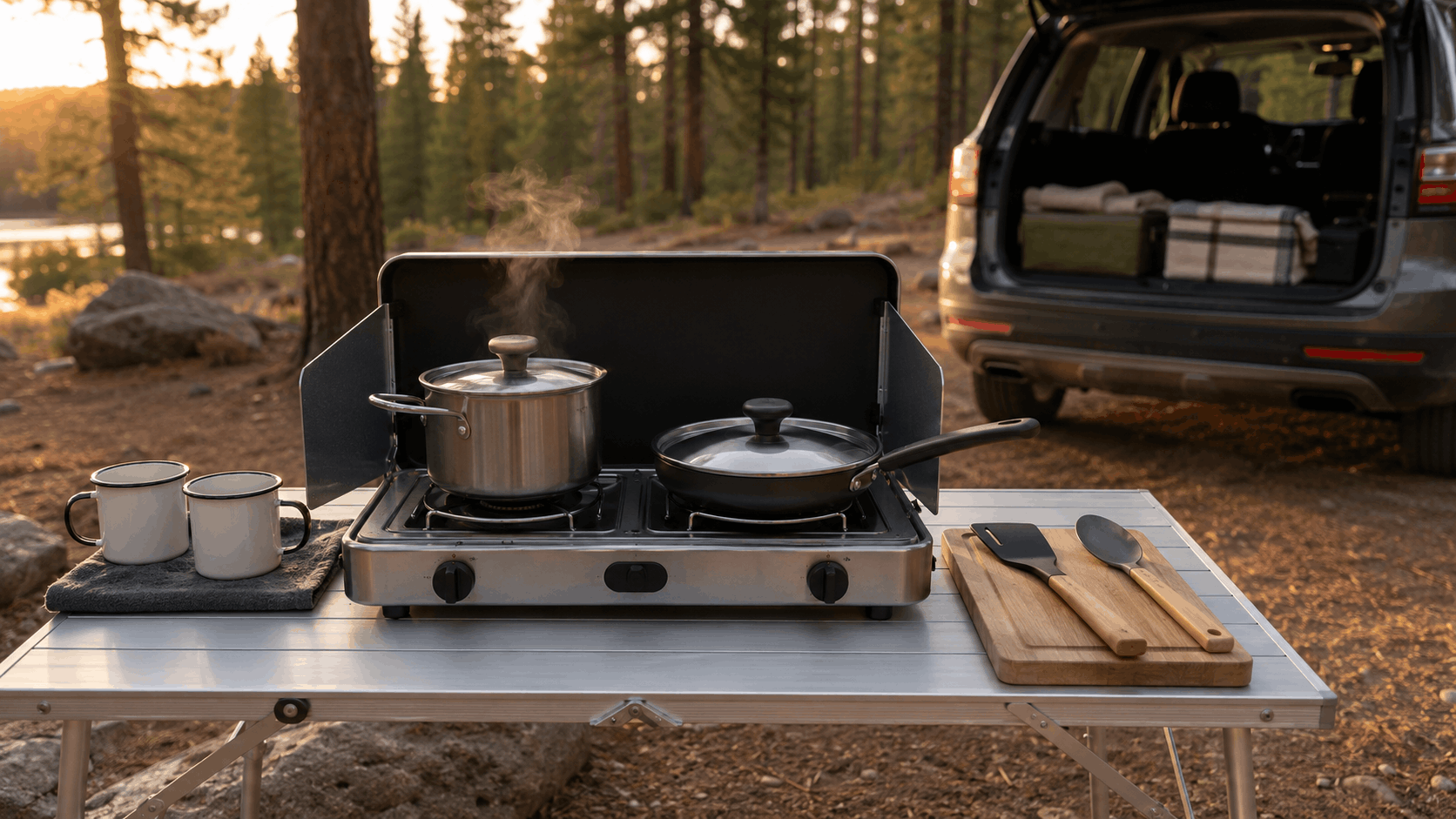
A good car-camping kitchen isn’t about owning a pile of gear. It’s about having one tight system: stove + cookware that heats evenly, packs cleanly, and doesn’t turn cleanup into your evening activity.
Below are the most efficient 2-burner stove + cook-kit pairings for 2025-style car camping—organized by how people actually cook at camp.
If you want the “big picture” car camping system (sleep / storage / power / cooling / kitchen / safety), this post plugs directly into The Complete Car Camping Setup Guide for 2025.
What “efficient” means for a camp kitchen (so we’re solving the right problem)
When people say “efficient,” they often mean “boils fast.” That’s part of it—but for car camping, real efficiency looks like:
1) Strong simmer control (not just blast heat)
If your stove can’t hold a low flame, you burn food and waste fuel restarting.
2) Wind resistance (fuel savings you’ll actually notice)
A good windscreen and burner design keeps your flame on the pot instead of heating the outdoors. OutdoorGearLab’s testing highlights how much windscreens and stove design affect real performance, not just BTU numbers.
3) Packability (everything nests)
The most efficient kitchen is the one you’ll actually set up—fast—when you’re hungry.
4) Cleanup time (the hidden tax)
Ceramic/nonstick or well-designed stainless matters. OutdoorGearLab notes the GSI Pinnacle Camper (car-camping favorite) has been updated to ceramic coating rather than Teflon.
Pick your cooking style first (30 seconds)
Use this to skip straight to the right combo:
Couple / simple meals: prioritize compact nesting + quick boil
Family / real cooking: prioritize space for two pans + controllable heat
Windy/coastal: prioritize windscreen + stable flame
Small car: prioritize the smallest packed volume
“Foodie camp” (sear + sauté): prioritize stable heat + cookware that can take it
Quick picks (fast recommendations)
Best overall “cook anything” combo: Camp Chef Everest 2X + GSI Pinnacle Camper
Best compact nesting combo: Jetboil Genesis Basecamp + Jetboil nesting pot/pan set
Best budget practical combo: Coleman Cascade-style 2-burner + Stanley stainless cook set
Best for wind + precise cooking: Camp Chef Everest 2X + MSR Quick 2 System (or similar nesting set)
Best “foodie camp” (sear, sauce, real meals): Eureka Ignite Plus + Lodge cast iron combo cooker
Best EU/UK premium vibe (looks good, works well): Primus Tupike + quality stainless nesting set
Now let’s do the full pairings with the “why.”
The most efficient stove + cook-kit combos (2025)
1) Camp Chef Everest 2X + GSI Outdoors Pinnacle Camper
Best for: families, two-pan meals, people who actually cook (not just boil water)
Why it’s efficient
OutdoorGearLab rates the Everest 2X as its top overall camping stove and calls out a nearly seamless windscreen and excellent simmer ability, with 20,000 BTUs per burner.
OutdoorGearLab also calls the Pinnacle Camper its favorite cookware for car campers, and notes the ceramic-coating update.
What to pack with it (minimal add-ons)
One silicone spatula + one spoon
A small “wash kit” pouch (sponge + soap + drying cloth)
Trade-offs
Stove is powerful and capable—but not the smallest option.
The cookset is great for basecamp-style cooking, but may feel like “too much” for a solo quick overnighter.
2) Jetboil Genesis Basecamp + Jetboil nesting pot/pan kit
Best for: small cars, neat freaks, anyone who wants the smallest packed kitchen
Why it’s efficient
The Genesis is designed to fold and nest; SFGate notes it can be purchased as a kit where the burners nest inside the cookware and pack into a carrying case.
CleverHiker praises fast boiling and low fuel use, but notes disappointment in its simmering/cooking evenly in their experience.
How to use this combo efficiently
Make it a “boil + sauté” system: pasta, rice, one-pan meals, breakfast.
If you do delicate sauces: test your lowest setting at home first.
Trade-offs
Best when you value packability and speed.
If your cooking style depends on gentle, consistent low heat, you may prefer a stove known for simmer control.
3) Coleman Cascade-style 2-burner + Stanley stainless cook set
Best for: budget builds that still feel organized
Why it’s efficient
GearJunkie lists the budget Coleman Cascade Classic as a solid value option.
SFGate’s testing highlights the Coleman Cascade as strong for low-heat cooking/control, while noting slower boil performance versus higher-BTU stoves.
Food & Wine lists the Stanley “Even-Heat” set as a value-friendly cookware option (stainless, compact, durable).
Setup tip that makes this combo feel “premium”
Store stove + cookware + utensils in one dedicated tote/bin (kitchen-only).
Keep spices in a small sealed box so you’re not chasing packets.
Trade-offs
Not the smallest and not the fastest boil.
Still totally workable if your meals aren’t “race-to-boil” focused.
4) Eureka! Ignite Plus + Lodge cast iron combo cooker
Best for: “foodie camp,” searing, and cooking in wind without babying the flame
Why it’s efficient
OutdoorGearLab describes the Ignite Plus as well-built, with a wide cooking area, good simmering, and robust design details.
OutdoorGearLab also recommends cast iron (including Lodge options) as great cookware for car camping when you care about cooking performance.
How to make cast iron efficient (so it’s worth the weight)
Preheat gradually, then cook—cast iron rewards patience.
Bring a dedicated scrubber + a small oil bottle for quick care.
Trade-offs
Heavier than other kits.
Cleanup and maintenance are a bit more “hands on,” but the food quality payoff is real.
5) Camp Chef Everest 2X + MSR Quick 2 System (or similar nesting set)
Best for: couples who cook “real meals” but want a tighter pack than a full family cookset
Why it’s efficient
Everest 2X: fast, powerful, and strong wind performance with excellent simmer ability (OutdoorGearLab).
OutdoorGearLab notes the MSR Quick 2 System as one of the higher-ranking sets for versatility in their cookware testing.
Make it even smoother
One pot becomes “water duty” (coffee + pasta). One pan becomes “food duty.”
Keep a small cutting board and one good knife in the kitchen kit—those two items reduce mess and time.
Trade-offs
Not as compact as the Jetboil nesting approach.
More capable for actual cooking than boil-only systems.
6) Primus Tupike + quality stainless nesting cookset
Best for: UK/EU campers, stylish durable setups, people who value easy cleaning
Why it’s efficient
Reviews commonly call out the Tupike’s thoughtful design and cleaning-friendly drip tray.
Regional practicality note
Fuel fittings and canister standards vary by country. For UK/EU travel, efficiency often means “I can buy fuel easily where I am” and “my connectors match.” (I keep this general on purpose—use the stove’s manual and local retailers to confirm compatibility.)
Trade-offs
Premium pricing.
Heavier than ultracompact systems—but great for car camping where comfort matters.
7) GSI Outdoors heat-exchanger cook kit + a wind-strong 2-burner stove (couples who care about fuel/time)
Best for: two people, lots of hot drinks, quick breakfasts, and fuel-conscious trips
Why it’s efficient
OutdoorGearLab’s cookware testing highlights that the Pinnacle Dualist HS uses a heat exchanger ring and was one of the fastest to boil in their tests, and it’s designed as a compact kit for two.
How to pair it
Pair this cook kit with a stove known for wind protection and control (like the Everest 2X) if you camp in exposed areas.
Trade-offs
Better for 2 than 4 (it’s built for pairs).
Heat-exchanger pots can be fussier around direct high heat—use steady, controlled flame.
The “no-fuss camp kitchen” checklist (what actually makes it efficient)
You can have the best stove in the world and still hate cooking if your kit is scattered. This is the minimal system that keeps things calm:
The core
Stove + fuel
One cook kit (pot + pan + lid)
Two utensils you actually use
One knife + small cutting board
Two bowls + two mugs (or whatever matches your group)
The wash kit (this saves the most time)
Small soap bottle
Sponge/scrubber
Drying cloth
Trash bag + a way to seal food scraps
The “kitchen bin” rule
Keep all kitchen items in one dedicated tote/bin so setup and teardown is automatic.
Safety notes (quick, important, and non-negotiable)
Cook with ventilation—always
Fuel-burning stoves can produce carbon monoxide. The CDC and CPSC both warn against using fuel-burning camping equipment in enclosed spaces like tents, campers, or vehicles.
Even “cracked windows” isn’t a guarantee. Treat stoves as outdoor-only tools.
Stable surface = safer cooking
Use a stable table or tailgate surface.
Level your stove if possible (it helps with pans, oil, and boil-overs).
Fuel and adapters: keep it boring
Different regions use different fuel canisters and connectors. Efficiency is staying within the stove’s intended fuel setup (and using manufacturer-approved accessories). SFGate notes that using a 20-lb tank can be done with a proper adapter on compatible stoves.
If anything feels improvised, skip it.
If you consider going out camping with your car, see this guide for the complete car camping setup.
