

Car Camping Ventilation & Bugproofing (2026): Window Screens, Fans, and Condensation Fixes for Sleeping in Your Car
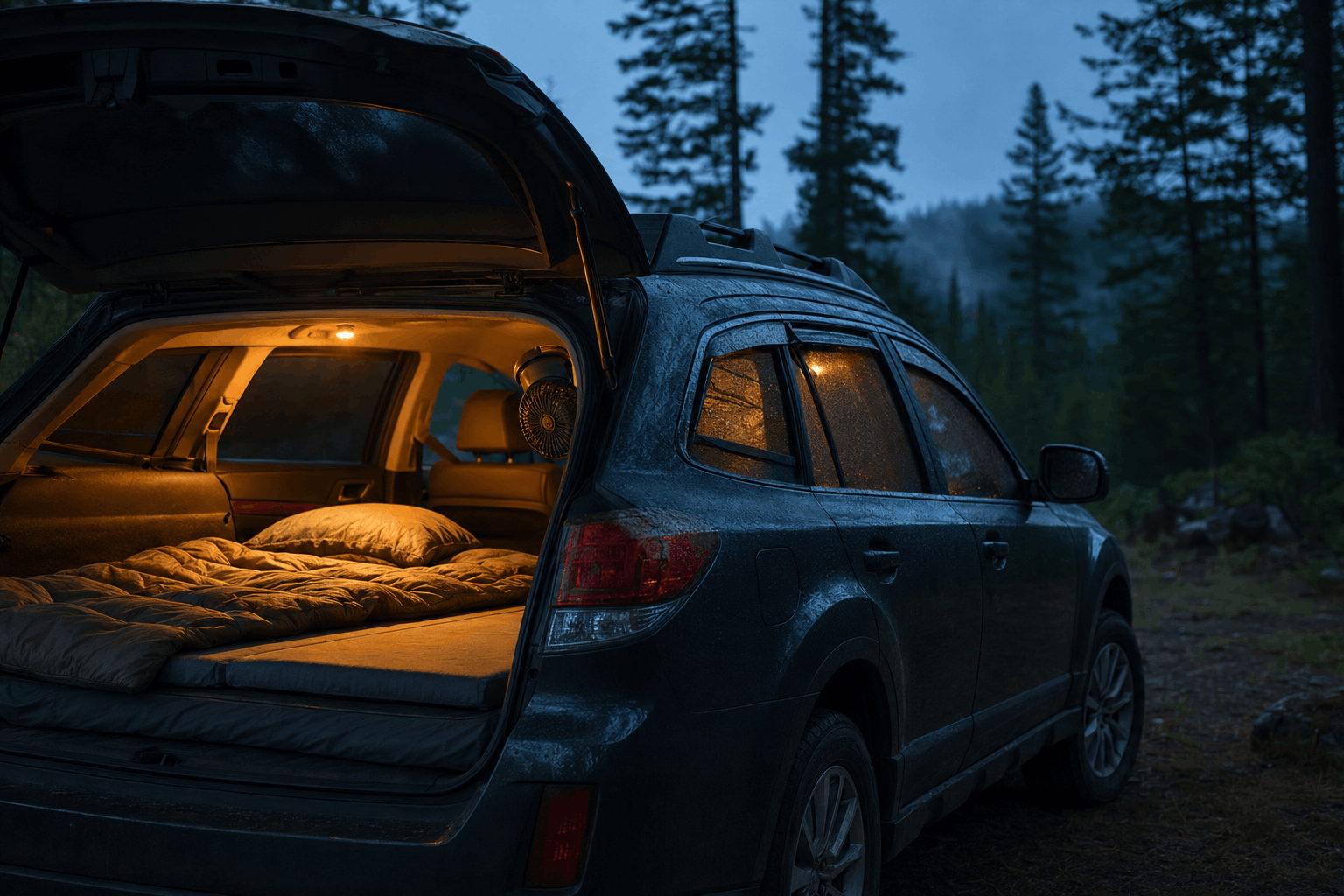
Sleeping in your car can be surprisingly comfortable—right up until the air goes stale, bugs find your ankles, and you wake up to wet windows and damp bedding.
If you’re building a full “comfort + organization” car camping system (sleep, storage, power, cooling, kitchen, and safety), start with The Complete Car Camping Setup Guide for 2025—then come back here to dial in ventilation, bugproofing, and condensation control.
This guide gives you a simple, repeatable system for:
Car camping ventilation and bugproofing (without inviting mosquitoes)
Picking window screens for sleeping in a car that actually fit your situation
Choosing and placing the best fan for sleeping in a car (quiet, efficient, and effective)
Fixing condensation in a car overnight—including what works in cold/wet shoulder seasons
Keeping airflow in rain without soaking your interior
No hype, no “one weird trick.” Just a setup you can use tonight.
The quick “90-second” setup (do this first)
If you do only one thing, do this:
Crack two windows (not one) on opposite sides for a cross-breeze. Even ½–1 inch is meaningful.
Add mesh/screens before sunset (bugs are faster than you are).
Put a fan on low to move air across your sleeping zone (and optionally a little toward the glass).
Keep moisture sources out of your cabin air (wet clothes, wet shoes, boiling water, damp towels).
That’s the core system: cross-breeze + bug barrier + gentle airflow + moisture control.
Safety note you shouldn’t skip
Ventilation is comfort and it’s part of basic safety. The big rule: don’t sleep with the engine running. It’s not worth the risk.
Public health guidance is clear about vehicle exhaust and carbon monoxide dangers, especially in semi-enclosed conditions (like garages) and when exhaust is obstructed.
Two extra details that matter in real life:
If your vehicle has a tailgate/hatch, opening it can pull exhaust toward the cabin unless you also have windows/vents open for airflow.
In winter, snow/ice can block a tailpipe—and carbon monoxide can seep back into the vehicle.
If you’re camping in cold conditions or around other vehicles, a small CO alarm can add a layer of reassurance—but the main safety move is still: engine off, airflow on. (If you’re not comfortable with any of this, consult a qualified mechanic about exhaust integrity.)
(Organizations referenced: Centers for Disease Control and Prevention, National Fire Protection Association.)
Step 1: Bugproofing your windows (choose your screen style)
Your screen choice depends on three things:
How much airflow you want
How much rain you expect
How stealth/secure you need to be
Option A: Slip-on “sock” window screens (fastest, great for beginners)
These are mesh sleeves that slide over the door frame. You roll the window down inside the mesh.
Best for: summer camping, mosquito zones, quick setup
Watch-outs: fit varies by vehicle; some block more airflow than you expect
Pro move: Use them on the two windows you’ll vent from most often (usually rear windows if you sleep in the back).
Option B: Magnetic DIY mesh screens (best fit per dollar)
If you’ve ever had “universal fit” fail you, this is your friend.
How it works: you cut mesh to fit and use magnets or magnetic tape around the perimeter to seal it.
Best for: custom fit, excellent bug seal, cheap replacement if torn
Watch-outs: some door frames aren’t very magnetic; test first
Pro move: Make two versions:
Max airflow (bigger mesh opening)
Stealth airflow (smaller opening that’s less visible from outside)
Option C: Window vent inserts (best for rain + security)
These are rigid inserts that sit in the window channel with a screened vent cutout. You can keep the window “closed” against the insert.
Best for: wet climates (UK / Pacific Northwest / coastal), stealthy airflow, parking-lot sleep
Watch-outs: more DIY time (or cost), but they’re worth it if you camp in rain often
If you’re mostly fair-weather camping, you can skip this. If you camp in consistent drizzle? This can be the difference between “fine” and “miserable.”
Step 2: Fans that work for sleeping in your car (without feeling like a wind tunnel)
When people search “best fan for sleeping in car,” they usually mean: quiet + low power + enough airflow to stop clammy air.
What matters more than brand
1) Power type (match your setup)
USB fan: easiest if you run a power bank or power station
12V fan: good if you’re using a 12V socket (but watch battery drain)
If you already have a power plan, keep this consistent. If you don’t, the simplest route is: USB fan + power bank.
2) Fan placement (this is where results come from)
Aim for circulation, not blasting your face.
Try this:
Fan at torso level, angled across your body (not directly at your nose)
If condensation is your main issue, angle it so some airflow reaches the glass (even indirect movement helps)
3) Mounting (so it doesn’t become a midnight problem)
A fan is only “quiet” if it’s not vibrating against plastic.
Good mounting options:
Headrest strap
Clip onto a rigid bin / platform edge
Hanging hook (if you have a cargo handle)
Bad mounting option:
Loose on the floor where it shifts and rattles at 2 a.m.
The “two-fan” upgrade (only if you need it)
If you camp in humid areas or shoulder seasons, two small fans often work better than one big one:
Fan 1: airflow across sleeping zone
Fan 2: gentle airflow toward windows (condensation control)
Start with one. Add the second only if you consistently wake up wet.
Why condensation happens in a car (and why cracking one window isn’t always enough)
Condensation is simple physics:
Your breath adds moisture (humidity) to cabin air.
Cold glass drops that air below its dew point.
Water appears on windows—sometimes a lot.
In a small sealed space like a car, humidity rises fast. That’s why “I cracked a window” sometimes still ends with dripping glass: the airflow wasn’t enough to exchange the damp air.
Condensation fixes that actually work (ranked from easiest to most effective)
Fix 1: Ventilate strategically (cross-breeze beats “one crack”)
Crack two windows on opposite sides. This turns a tiny opening into actual air exchange.
Good starting point: ½–1 inch per window
If it’s cold: start smaller, add a fan, and build up only as needed
Fix 2: Remove moisture sources from the cabin air
This is the sneaky one. Your bedding might be fine—but your stuff isn’t.
Before bed:
Put wet shoes in a bag/bin (or outside under the car if safe/legal)
Don’t dry wet clothes inside the cabin overnight if you can avoid it
Keep a dedicated “wet stuff” tote
If you cook in/near the car: steam is moisture. Vent aggressively during cooking, then reset airflow.
Fix 3: Use window insulation/barriers to reduce wet glass
Even with airflow, cold glass makes condensation easier. Window covers/insulation reduce the temperature difference and help a lot in shoulder season.
What to use:
Reflective window covers
Insulated curtains (for vans/SUVs)
Even a fitted sunshade helps on a single big window
This doesn’t replace ventilation—it makes ventilation more effective.
Fix 4: Add gentle airflow across the glass
This is where the fan earns its keep. You’re trying to prevent still, humid air from “sitting” against cold windows.
On a cold night:
Crack two windows slightly
Run fan on low for continuous circulation
Fix 5: Moisture absorbers (only as a supplement)
Silica packs, dehumidifier bags, or similar can help a bit—especially for short trips or “I parked with wet gear” situations.
But they’re not a replacement for airflow. Think of them like a sponge in a bathtub with the faucet on: helpful, but not the main fix.
Rain-proof ventilation (how to keep airflow without letting water in)
Rain changes your priorities. Now it’s airflow and water management.
Strategy A: Vent from the “top gap”
Cracking windows at the top edge often reduces direct splash-in compared to lowering them further.
Strategy B: Use vent inserts if you camp in regular rain
If you’re camping in the UK or coastal/wet regions, vent inserts can keep airflow consistent through long drizzle without waking up to damp seats.
Strategy C: Tarp angle (campground-friendly, not stealthy)
If you’re at a campsite and you have room, a tarp angled over the window side can let you open more without taking water inside. Not always necessary—but it can save a trip.
Bugproofing beyond window screens (small habits, big difference)
Window screens do most of the work. These habits clean up the rest:
Enter/exit fast after dark (don’t leave doors open while you reorganize)
Keep bright interior lights off near open windows (it attracts insects)
If you can choose your spot, avoid setting up right next to standing water
Pick your setup: three “recipes” you can copy tonight
1) Hot + buggy summer night (max airflow)
Two windows cracked (opposite sides)
Mesh screens installed before sunset
Fan on low across your body
Light discipline after dark
2) Cold + wet shoulder season (condensation control)
Two windows cracked slightly (start small)
Fan on low all night
Window covers/insulation on the coldest glass
Wet gear isolated in a bin/bag
3) Rainy night (UK-style drizzle)
Vent inserts (or minimal top-gap venting)
Screens in place
Fan on low for circulation
Keep towels/wet jackets out of the sleeping area
Troubleshooting: symptom → fix
“My windows are soaked by 2 a.m.”
Increase cross-breeze (two windows, slightly wider)
Add low fan circulation
Remove wet gear from cabin air
Add window insulation on biggest glass surfaces
“Bugs still get in”
Check for gaps at the top corners of your screens
Make sure mesh overlaps the full opening area
Reduce interior light and speed up door-open time
“I feel clammy even with a cracked window”
Add a fan (air movement matters)
Vent two windows instead of one
Move moisture sources (wet clothes, damp towels)
“Rain is blowing in”
Reduce opening size and switch to top-gap venting
Reposition to the lee side (away from wind)
Consider vent inserts if this is a frequent pattern
Next step: build the full “comfortable car camping” system
Ventilation and bugproofing are one piece of the bigger car camping setup—right alongside sleep comfort, storage, power, cooling, kitchen, and safety.
When you’re ready to put the whole system together, start here: The Complete Car Camping Setup Guide for 2025
